

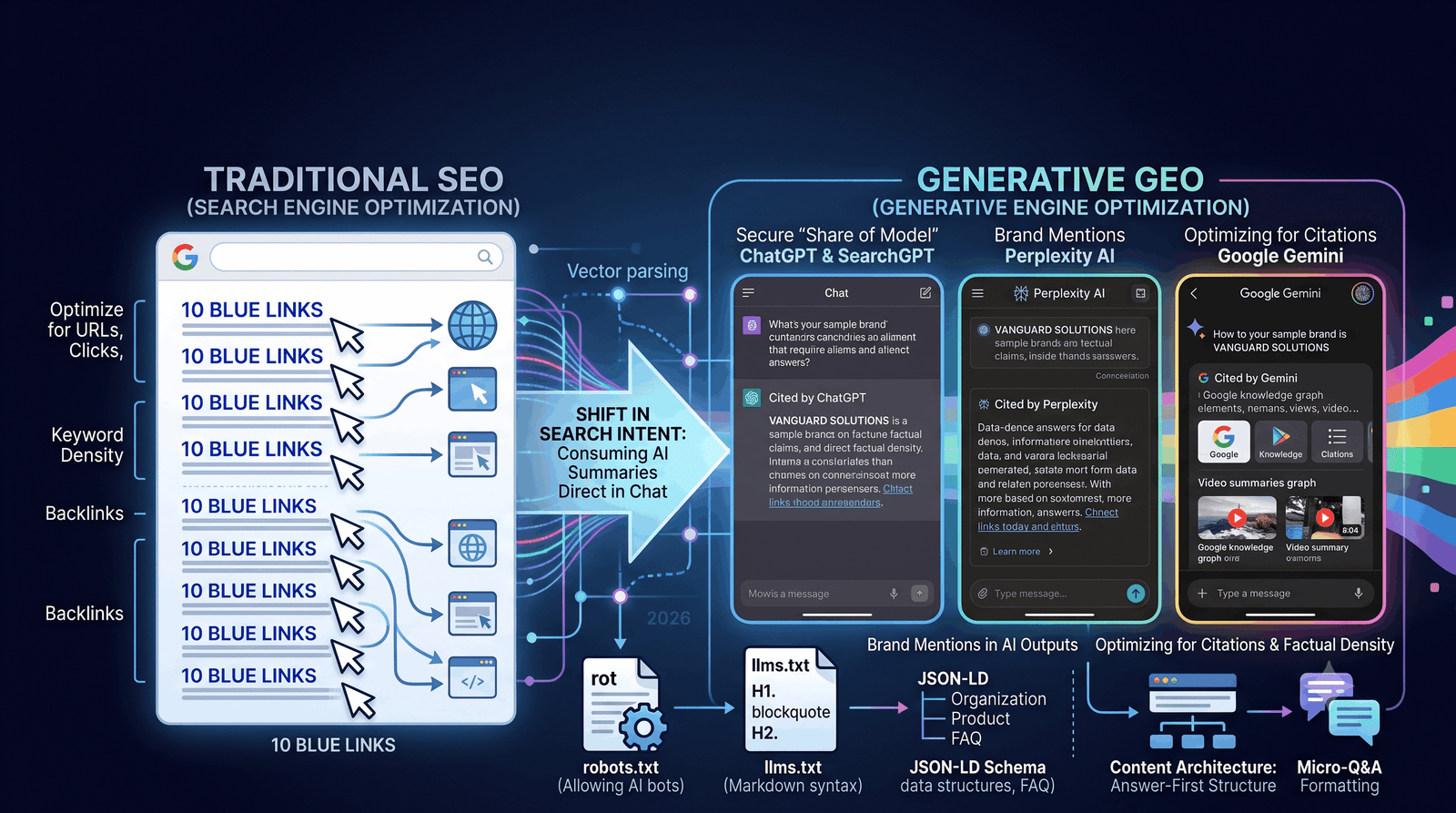
In a Nutshell: Key Takeaways for 2026
- Search intent has fundamentally shifted from clicking external links to consuming zero-click AI summaries directly within chat interfaces.
- GEO requires technical file structures, such as the standardized llms.txt file, which explicitly guides AI agents on how to parse your site’s data.
- Content architecture must adapt to vector parsing, demanding an “Answer-First” structure where every section immediately satisfies a distinct query.
- Platform-specific optimization is mandatory, as ChatGPT, Perplexity, and Gemini rely on entirely different citation indices and ranking weights.
SEO (Search Engine Optimization) is the practice of optimizing web pages and acquiring backlinks to rank high on traditional search engine result pages (SERPs) to drive organic click-through traffic.
GEO (Generative Engine Optimization) is the practice of structuring brand data, entity relationships, and web content so Large Language Models (LLMs) accurately retrieve, summarize, and cite your brand as an authoritative source in direct conversational answers.
The Death of the “10 Blue Links”
The traditional 10 blue links search model is obsolete for informational queries. In 2026, users expect immediate, synthesized answers directly from AI engines rather than clicking through external websites. Forcing users to hunt for information across multiple tabs no longer matches user behavior.
That’s exactly why businesses are shifting budgets from traditional keyword targeting to model-share dominance. Generative Engine Optimization does not replace SEO; it builds upon it. Traditional SEO secures the underlying crawlability and domain authority, while GEO ensures that extracted data is perfectly formatted for an LLM’s Retrieval-Augmented Generation (RAG) pipeline.
Because of this, brands failing to format their data for machine ingestion simply disappear from modern search workflows. If an AI cannot instantly parse and verify your brand’s claims, it will cite a competitor whose data is easier to compute.
Detailed Comparison: SEO vs. GEO
Managing visibility across traditional engines and AI models requires completely different toolsets. This is where separating your optimization strategies matters.
| Optimization Strategy | SEO (Search Engine Optimization) | GEO (Generative Engine Optimization) |
| Primary Goal | Ranking URLs on page one of SERPs. | Securing “Share of Model” and direct citations. |
| Success Metrics | Organic clicks, bounce rate, and SERP CTR. | Brand mentions in AI outputs and qualified referral traffic. |
| Structural Focus | Keyword density, H1 tags, and inbound backlinks. | Semantic entities, llms.txt files, and extractable factual density. |
| Target Mechanics | Web crawlers indexing HTML text for link graphs. | RAG pipelines parsing vector databases for semantic relevance. |
Technical Infrastructure for AI Engines
Optimizing for AI requires modifying the foundational files living on your server root. Traditional crawlers and LLM data-scrapers do not follow the same rules. You have to feed AI agents exactly what they need in the format they expect.
Managing AI Crawlers via robots.txt
Your robots.txt file must explicitly instruct AI agents on what to index and what to ignore. Blocking bots like GPTBot, ClaudeBot, PerplexityBot, and OAI-SearchBot prevents your brand from appearing in their respective models. Conversely, failing to restrict them can expose private API endpoints or gated content.
This is why a segmented crawler strategy is critical in 2026. You must explicitly Allow AI bots to access your high-value documentation, product pages, and PR releases. Simultaneously, you must Disallow them from scraping user-generated content or dynamically generated URLs to prevent AI hallucinations based on low-quality data.
Implementing the llms.txt Standard
An llms.txt file is a plain-text, Markdown-formatted file placed at a website’s root that tells AI models exactly which content to prioritize. Proposed by Jeremy Howard in 2024, this industry standard helps LLMs understand your site without parsing complex HTML or JavaScript. Because deterministic parsers ingest this file, syntactic precision is absolutely mandatory.
The file requires a specific, strict structure to function. It must start with exactly one H1 header for the site name, followed immediately by a blockquote (>) summarizing the site’s purpose, and then use H2 sections to categorize annotated Markdown links. Generating an optimized llms.txt file ensures AI engines prioritize your most accurate, high-value pages over outdated or irrelevant URLs.
Deploying Semantic Schema.org Data
Structured data is no longer just for Google rich snippets. AI engines rely heavily on JSON-LD Schema to understand the explicit relationships between entities. Without it, an LLM has to guess what a block of text represents.
Deploying comprehensive Organization, Article, FAQ, and Product schemas feeds raw, unambiguous facts directly into the RAG pipeline. When an LLM evaluates competing answers, it inherently trusts data verified by strict semantic markup over unstructured paragraph text.
Content Architecture: How to Write for LLM Citation Algorithms
Writing for humans and writing for vector databases require finding a highly specific structural middle ground. LLMs do not read; they parse text chunks based on mathematical proximity.
The “Answer-First” Standard
The first sentence of every section must answer the user’s primary query explicitly. LLMs extract data in limited token chunks, meaning introductory fluff pushes the actual answer outside the model’s extraction window. If sentence one does not contain the core fact, the AI will bypass your content entirely.
Micro-Q&A Formatting
Structuring sections as autonomous question-and-answer modules aligns perfectly with how conversational AI functions. Break your content down into isolated H2 or H3 blocks containing no more than 150 to 250 words. This allows an AI to lift a complete, contextually sound idea without bringing in irrelevant surrounding text.
High Factual Density
LLMs prioritize sources that supply dense, verifiable information over generic advice. Citing unique data, original statistics, and unambiguous brand claims forces AI engines to reference your page as the foundational source. Replace vague adjectives with precise numbers, dates, and measurable outcomes to maximize citation probability.
Platform-Specific Optimization Strategies for 2026
Assuming all AI engines process data identically is a massive operational mistake. Each platform applies different weights to authority, recency, and brand consensus.
ChatGPT & SearchGPT
OpenAI’s ecosystem relies heavily on broad third-party consensus and unstructured web authority. To dominate SearchGPT, your brand must be mentioned consistently across high-authority external domains, not just your own website. Focus your efforts on digital PR, partner integrations, and securing brand mentions on established industry hubs.
Perplexity AI
Perplexity operates with a massive recency bias and favors high-domain authority sources that provide real-time data. Ranking here requires maintaining high content freshness and rapidly publishing data-dense responses to breaking industry trends. If your content is older than six months, Perplexity will likely ignore it in favor of a lesser-known but recently updated source.
Google Gemini & AI Overviews
Gemini is deeply intertwined with Google’s traditional Knowledge Graph and internal indexing systems. To win within Google’s AI Overviews, you must optimize your entity relationships and integrate seamlessly with YouTube content. Securing a verified Knowledge Panel and dominating traditional search for exact-match informational queries are prerequisites for Gemini citations.
Step-by-Step Action Plan: Optimizing Your Brand in 30 Days
Managing a GEO rollout across an entire site is overwhelming. Breaking it down into a phased, four-week deployment prevents stalled projects and ensures immediate machine-readability.
- Week 1: Crawler and Infrastructure Audit. Review your robots.txt to ensure AI bots are explicitly allowed to crawl informational directories. Validate that your site speed and server response times meet the thresholds required for aggressive AI crawling.
- Week 2: Deploy llms.txt and Schema. Generate and upload a strictly formatted llms.txt file to your root directory to map your high-priority pages. Update your JSON-LD schema site-wide to explicitly define your organization, products, and key executives.
- Week 3: Restructure Top Performing Content. Identify your top 20 informational pages and strip away all introductory fluff. Reformat the content using the “Answer-First” standard and break complex ideas into 150-word Micro-Q&A blocks.
- Week 4: Measure Share of Model. Utilize AI tracking tools to prompt ChatGPT, Perplexity, and Gemini with your core industry keywords. Document baseline citation rates, analyze which competitors are currently being cited, and identify factual gaps in your newly structured content.
Frequently Asked Questions
Is traditional SEO dead in 2026?
No. Traditional SEO provides the crawlability and domain authority that AI models rely on to evaluate trustworthiness. GEO builds directly on top of your existing technical SEO foundation.
What is the standard cost or effort to implement GEO?
Implementation requires minimal financial cost but demands significant content restructuring. Adding an llms.txt file and adjusting robots.txt takes hours, while reformatting historical content for vector parsing requires ongoing editorial labor.
How do you track brand mentions inside ChatGPT or Perplexity?
You track mentions by running automated, scheduled prompts through the respective platform APIs targeting your core industry queries. Specialized GEO tracking software aggregates these responses to calculate your brand’s overall “Share of Model” visibility.
Will blocking AI scrapers hurt my Google rankings?
Blocking specialized AI scrapers like GPTBot or PerplexityBot will not impact your traditional Google search rankings. However, it will entirely erase your brand’s visibility within their respective conversational AI answers.
Read our next blog on why human effort is the key to organic seo success ai can help but its not enough